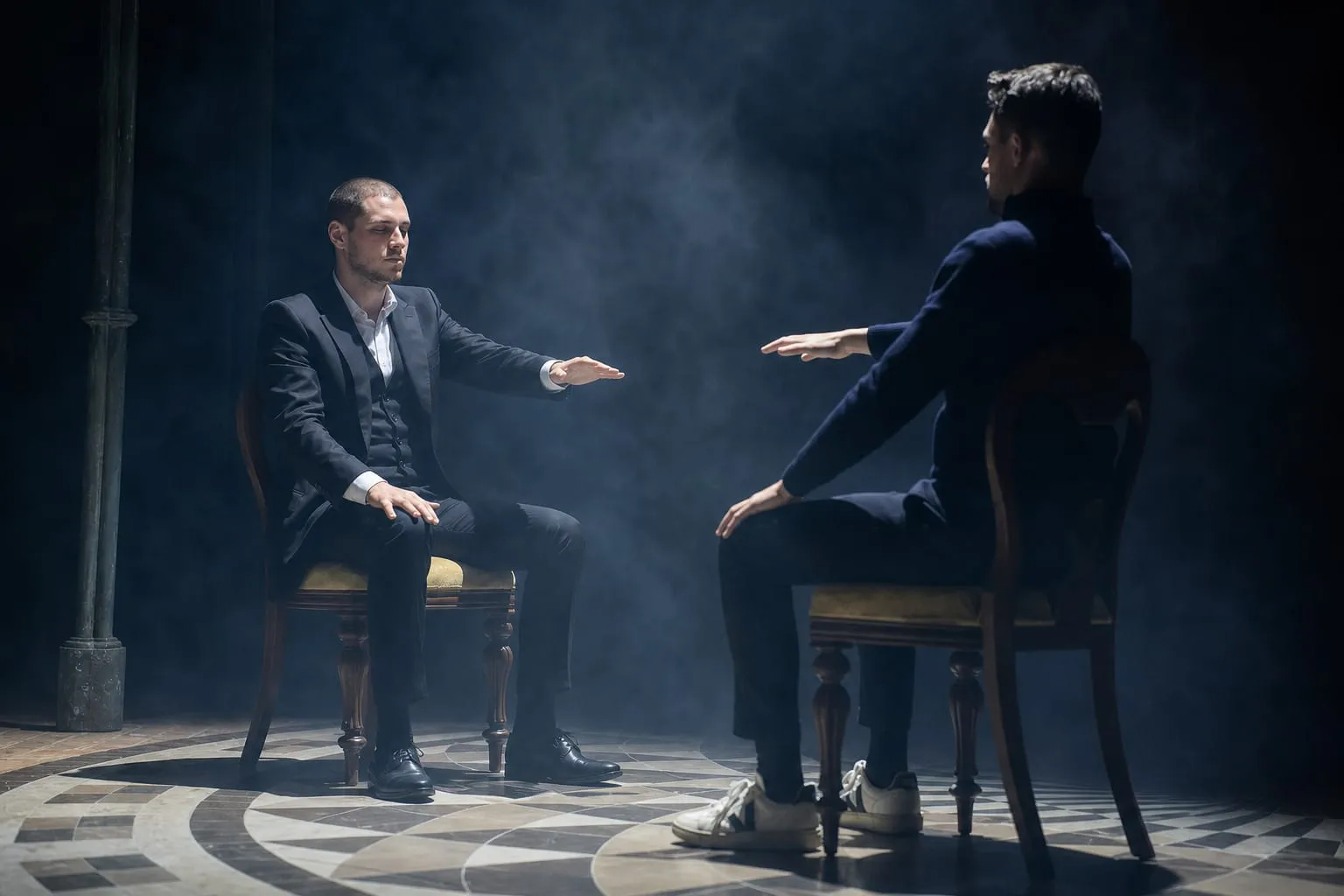
Yonatan Lavy and a participant seated opposite one another during a live mentalism performance
A verified live frame: Yonatan Lavy and a participant in conversation. The photograph establishes the encounter, not the participant's private state.

Body Language: Read the Room, Not the Pose

Your first read is fast. Your second can be useful. Start with what a camera could prove, widen to the room, then change one small thing and watch what happens next.

Artist field note by Yonatan Lavy7 min read

A clue gets weaker when the frame gets smaller

Begin with the fact that survives a photograph. Then keep widening until the room can disagree with your first story.

Two sentences are competing. Which one could a camera verify?

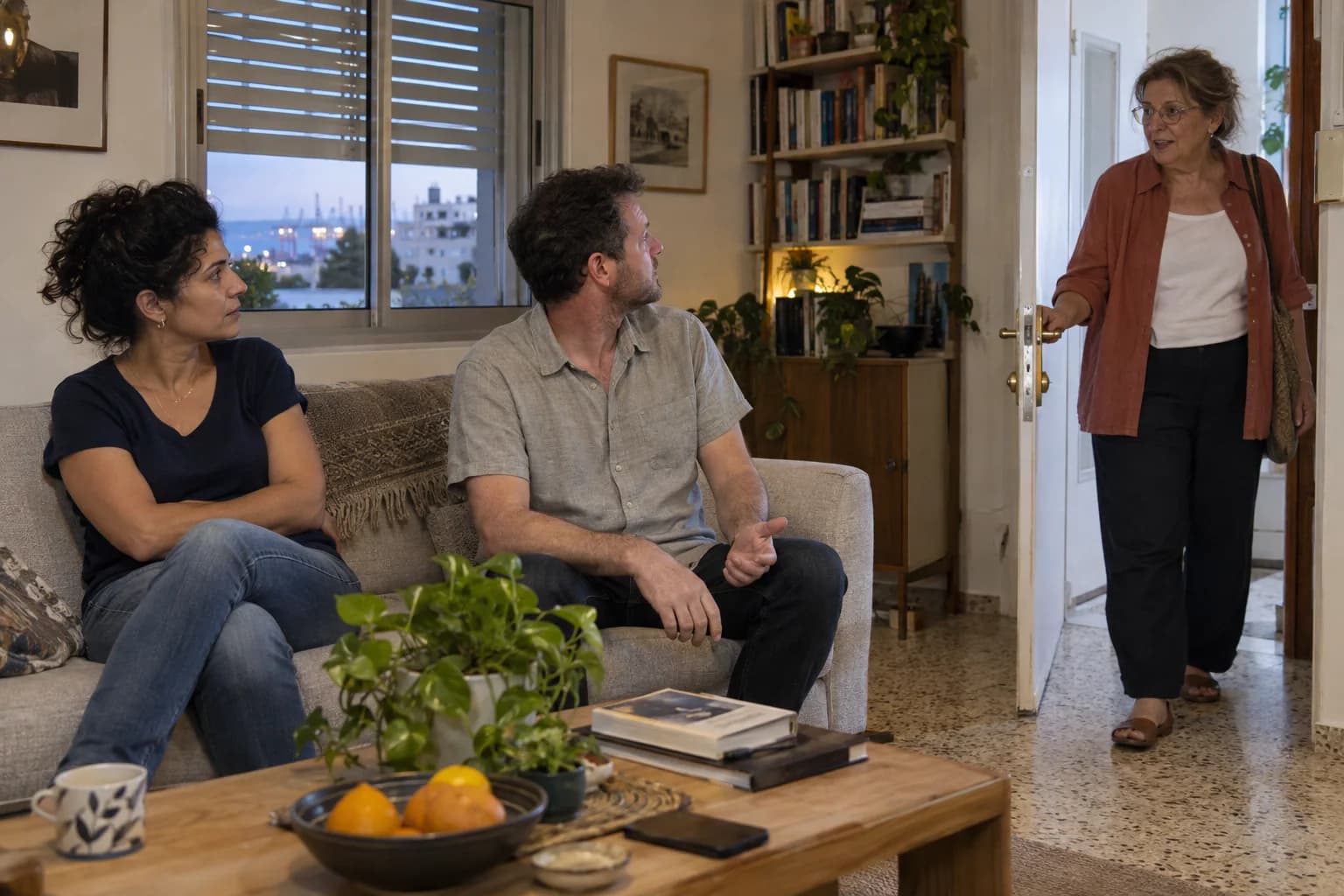
Two fictional adults in a lived-in room; one is fully visible with both hands open during conversation, alongside chairs, a doorway, window, lamp, table, and the second adult
The same open-hand detail changes meaning as the frame expands from hands to body to room.

Now widen the same frame without moving the photograph.

Start with the visible hands. Name their position, not the person's character.

Generated staged adults for observation practice. The image illustrates visible geometry, not a witnessed event or a private state.

Rule: Visible hands can make an invitation easier to follow, but the hands do not carry the person's private reason. The body, the partner, the distance, and the available route all belong to the same observation.

Reversal: The reversal is simple: more context usually creates less certainty about the story and more certainty about the next considerate move.

Move: describe one visible change, widen once, then choose an adjustment you can undo.

Arms, legs, chair, gaze, and direction are one sentence

A pose dictionary isolates one body part. A useful observation follows how the whole person is arranged inside the available space.

Two fictional adults converse in a lounge; one sits with arms held loosely across the torso beside a cool window, a nearby throw, chairs, and warm interior light
The arms are visible. So are several contexts that could fit them. The cause remains open.
Two fictional adults converse while one keeps looking toward the other and sits with chair, torso, knees, and feet angled near a clear doorway route
Gaze can remain with the conversation while the rest of the body preserves another direction.

Rule: Arms held close are visible. So are a cool window, a chair arm, the distance between people, and whether the rest of the body keeps participating. None of those objects supplies a private cause by itself.

Reversal: A listener may keep looking at the speaker while the chair, knees, or feet preserve a clear route toward the door. That conflict is worth accommodating, not diagnosing.

Move: shorten the next beat, restore an easy watching path, and see whether the visible geometry changes.

Generated staged study with a fictional adult. Observe movement only; it is not event evidence, diagnosis, or lie detection.

Two fictional adults maintain eye contact across a plain table with both faces, hands, and upper bodies visible in a neutral room
The eye lines meet. The photograph says nothing about whether either statement is true.

Eye contact is not a truth meter

The most familiar body-language shortcut is also one of the easiest to manage deliberately.

Rule: In a field interview study at an international airport, people who lied displayed more deliberate eye contact, not less. The finding overturns a popular shortcut without creating a replacement tell.

Reversal: The useful conclusion is smaller and stronger: gaze can be managed. Keep it out of the verdict business and return to the words, the whole body, the room, and the sequence.

Move: when truth or comfort matters, ask a neutral question instead of turning a gaze pattern into an answer.

Generated staged study with a fictional adult. Observe movement only; it is not event evidence, diagnosis, or lie detection.

The next frame can teach more than the first

A reversible adjustment creates a cleaner comparison than a harder guess.

Rule: Pause, clarify the role, step back half a pace, lower the social pressure, or make watching visibly complete. Then compare what changes and what stays the same.

Reversal: If movement releases, you learned that the adjustment helped the moment. You still did not learn the private reason for the earlier stillness.

Move: make one small change, keep it if the room reads more clearly, and remain willing to change again.

The same two fictional adults appear in three staged moments: close conversational distance, one ordinary step back, and a later frame with more space and a changed resting posture
The adjustment is visible. The private reason for the earlier posture is not.

Generated staged study with a fictional adult. Observe movement only; it is not event evidence, diagnosis, or lie detection.

Four moves worth remembering

In English, READ is a compact way to carry the corridor into a real room.

  1. Range

    Widen from the visible detail to the whole body, nearby people, and the room.

  2. Exact observation

    Name only what a camera could verify before adding a cause or emotion.

  3. Arc

    Compare before, during, and after. The sequence is usually more useful than the pose.

  4. Decide

    Pause, clarify, step back, or restore a choice. Then compare the next frame.

READ is a memory device, not a diagnostic system. It improves the next move; it does not reveal a lie, consent, or a private thought.

The Observation Theatre

Five rooms. Five tempting stories. Choose the sentence the image can actually support, then take one reversible move into the next scene.

Scene 1 of 5

What do the open palms let you say?

Three fictional adults stand in a ceramics workshop; one woman shows both open palms while all three bodies, feet, worktables, and the room remain visible
Visible hands can clarify an invitation. They cannot certify the person behind it.

Generated staged adults for observation practice. These scenes are not documentary evidence and no pose establishes emotion, honesty, consent, or intent.

Where this body-language rule fits

Best when

  • The format allows the performer to see both the participant and the wider room clearly enough to follow a change over time.
  • The host wants participation to remain adjustable, with watching treated as an equally valid role.

Adapt when

  • Sightlines are limited, by relying more on direct verbal choice and less on reading subtle room-wide changes.
  • A cue remains ambiguous, by choosing space, clarity, and an easy exit instead of assigning an emotion or intention.

Ask how the room can be read in real time

Share the room, sightlines, seating, sound, and desired level of participation. The useful question is whether the format can respond to visible feedback while keeping each guest's role adjustable and the final result unexplained.

Discuss the room and format

Accessibility

Adjust the site’s text, colors, motion, and reading aids. Changes apply immediately.

Text adjustments

Font size

Scale all site text from its original size without reducing headings.

Line height

Add vertical space between lines of text.

Text spacing

Adds letter spacing in English. Hebrew uses word spacing so letter shapes remain intact.

Text alignment

Align eligible headings and prose without moving page layouts.

Color adjustments

Contrast

Choose a semantic high-contrast palette while keeping images and controls intact.

Saturation

Reduce or increase color intensity. This combines with contrast and grayscale.

Content highlighting

Navigation and reading

Keyboard navigationUse Tab and Shift+Tab to move, Enter or Space to activate, and Escape to close dialogs. Focus indicators stay visible.Always active
Cursor size

Enlarge the mouse or pen pointer across site content and controls.

Cursor size affects mouse and pen input only; touch screens do not display a cursor.